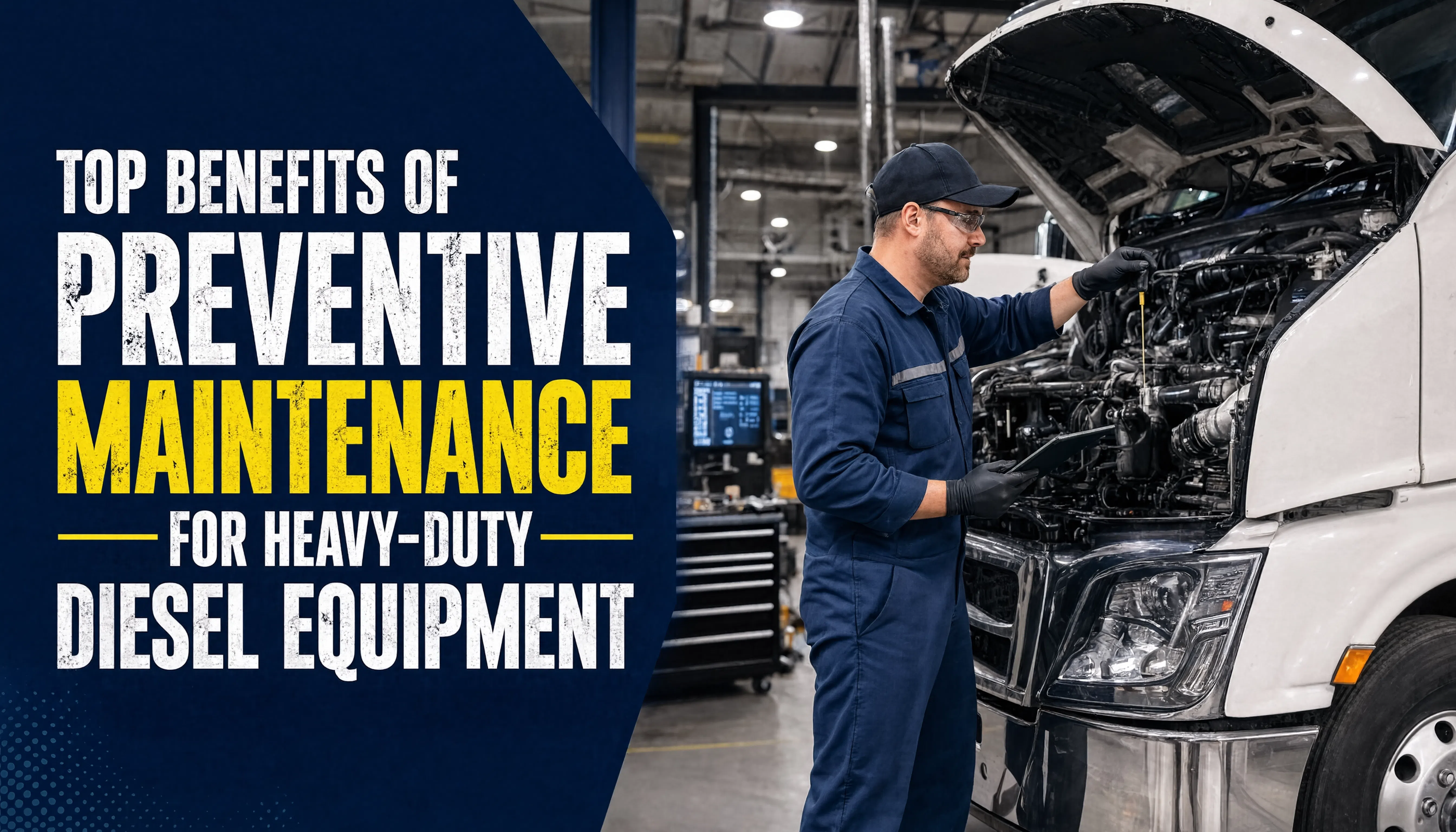
Top Benefits of Preventive Maintenance for Heavy-Duty Diesel Equipment
One simple fact stands out: trucks generate revenue when they're on the road not when they're sitting in the repair bay. Preventive maintenance keeps your fleet operating reliably, minimizes unexpected downtime, and extends engine life. Partnering with a reliable diesel repair shop for consistent maintenance is one of the smartest investments a fleet can make. When neglected, minor issues turn into costly repairs, increased downtime, and lost productivity that can impact operations for years.
Here are the top benefits of preventive maintenance for heavy-duty diesel equipment, and how they translate into dollars for fleets running in the Houston metro and Gulf Coast markets.
Reduced Unscheduled Downtime
Unplanned downtime for a truck can quickly become a costly setback. Every hour a truck is out of service means lost revenue while expenses such as payroll, insurance, and equipment costs continue. For fleets supporting hot-shot deliveries, oilfield operations, or other time-sensitive projects, a single breakdown can delay schedules, disrupt operations, and increase overall operating costs.
Longer Engine and Component Life
Heavy-duty diesel engines are built to deliver 750,000 to 1,000,000 miles of reliable performance, but only with consistent preventive maintenance. Delaying routine services such as oil changes, coolant replacement, or air filter inspections can accelerate engine wear, reduce efficiency, and increase the risk of costly failures, including turbocharger damage and cooling system issues.
A proactive preventive maintenance program helps maximize the service life of the engine, drivetrain, and chassis while reducing unexpected repairs. For fleet operators, extending the lifespan of each truck by even a few years can significantly lower replacement costs, improve asset utilization, and maximize return on investment.
Better Fuel Economy
A small drop in miles per gallon across a fleet is invisible on any single truck and enormous on the balance sheet. Preventive maintenance directly affects fuel economy through:
Clean air filters that let the turbo build full boost
Clean fuel filters that let the injection pump deliver rated pressure
Injectors spraying to spec, not dribbling
Correct tire pressure on all positions, which is a PM inspection item
Aligned drive and steer axles that do not scrub
Wheel bearings without preload issues
A quarter-mile-per-gallon improvement on a tractor running high annual mileage translates to meaningful savings at current diesel prices. Across a fleet of twenty, that adds up to real money on the balance sheet that only a maintained truck can produce.
Lower Repair Costs
Every failure has a cheap window and an expensive window. A leaking coolant hose caught on inspection is a small parts cost and a short labor job. The same hose that fails on the road can take out a water pump, cook the engine, and hydro-lock a cylinder. That is a rebuild.
Preventive maintenance is the mechanism that keeps failures in the cheap window. Studies of well-run fleets consistently show that Preventive maintenance programs deliver a strong positive return, with every dollar spent on preventive maintenance producing multiple dollars in avoided repair costs.
DOT Compliance and Reduced Violations
The Federal Motor Carrier Safety Administration requires documented periodic inspections on every commercial vehicle. A carrier that shows up to a compliance review with clean, complete Preventive maintenance records handles the audit and moves on. A carrier without those records faces fines, out-of-service violations, and CSA score damage that raises insurance premiums for years.
A structured PM program produces the documentation automatically. It is not an extra step. It is a byproduct of doing the work.
Higher Resale Value
Fleet trucks with complete maintenance histories sell for 15 to 25 percent more at auction than trucks with no records. Buyers know the difference between a maintained truck and a neglected one, and they pay for it. When you trade a fleet on a five-year cycle, that resale premium can offset a significant portion of the Preventive maintenance program cost.
Driver Safety and Retention
Drivers notice when their assigned truck runs well and when it does not. Maintained equipment leads to fewer roadside failures, fewer white-knuckle moments on wet pavement with marginal brakes, and less driver frustration. In a market where good drivers are hard to find and keep, running maintained equipment is a retention lever.
What a Real Preventive Maintenance Program Looks Like
A working preventive maintenance program has these elements:
A-service (every 15,000 to 25,000 miles): oil and filter change, chassis lube, visual inspection, air dryer check
B-service (every 45,000 to 75,000 miles): A-service plus fuel filters, air filter, DEF filter, and full brake inspection
C-service (annual or 100,000 miles): B-service plus coolant service, transmission and differential fluid, wheel bearing inspection, and DOT inspection
Documented inspection sheets with signatures, mileage, and date
A tracking system that schedules the next service before the current one closes
For fleets that do not want to run their own shop, partnering with our fleet diesel maintenance services delivers the same benefits without the overhead of running a shop yourself.
FAQ
Q: What is included in a preventive maintenance inspection?
A: A full PM inspection covers engine oil and filters, fuel and air filters, cooling system, brakes and air system, tires and wheels, lights and electrical, steering and suspension, driveline, exhaust and aftertreatment, and a road test. Complete PM inspections take two to four hours per unit.
Q: How much does preventive maintenance cost for a diesel truck?
A: Preventive maintenance costs vary with engine size, aftertreatment system, service tier (A, B, or C), and regional labor rates. Basic A-service (oil and filters, inspection) is the most affordable tier. B-service adds fuel filters and brake inspection. Annual C-service including DOT inspection is the most comprehensive tier. Contact a diesel shop for pricing specific to your equipment.
Q: Does preventive maintenance actually save money?
A: Yes. Studies of managed fleets consistently show that PM programs deliver a strong positive return, with every dollar invested producing multiple dollars in avoided repair costs, plus the value of reduced downtime and extended equipment life. The return grows with fleet size.